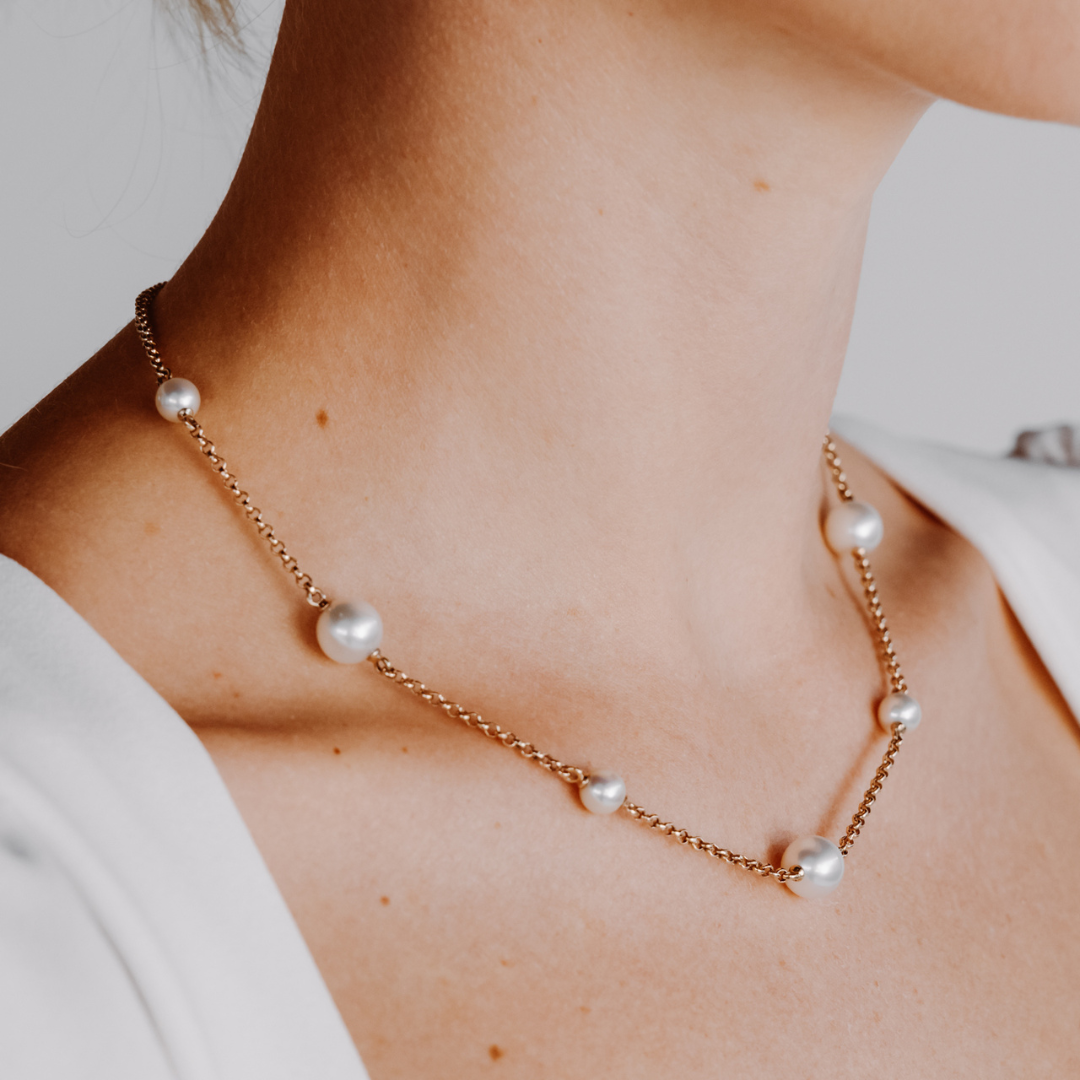
什么是淡水珍珠?它与海水珍珠有何不同?
淡水珍珠产出速度快,数量多,劳动强度低,价格也更便宜。相比之下,海水珍珠养殖周期较长,而且数量稀少,因此价格较高。
了解淡水珍珠和海水珍珠之间的区别很重要,这样您在购买下一件珍珠首饰时就可以做出明智的决定。
人们通常不太了解淡水珍珠和海水珍珠之间的区别——我们不会责怪您!这是一个令人困惑的区别,我们收到了很多关于这个话题的问题。因此,我们整理了一篇文章供您阅读,希望您读完后能知道并理解两者之间的区别。
Freshwater pearls are produced quickly and in greater quantities, making them less labour-intensive and more affordable. In contrast, saltwater pearls require a longer cultivation period and are rarer, resulting in higher prices.
Saltwater pearls are typically larger and have a finer nacre quality, leading to better lustre compared to freshwater pearls.
Freshwater pearls often undergo treatments to achieve their final colour, while saltwater pearls, like those from Pearls of Australia, maintain their natural hues.
由于其稀有性和品质,海水珍珠通常被认为更有价值,是一项值得的投资。淡水珍珠虽然同样美丽,但更容易获得,形状和颜色种类繁多,价格也更低。
淡水珍珠产自三角贝和Hyriopsis schlegeli或琵琶贝。这些贝壳生长在河床、湖泊、小溪和池塘等淡水水体中。虽然一些淡水珍珠产自美国和日本,但它们主要产自中国。淡水珍珠通常很小且形状不规则。这是由于它们的养殖过程造成的。
与所有类型的养殖珍珠一样,淡水珍珠是通过技术人员将刺激物引入贝壳内膜的过程生成的。这个过程会激活贝壳的防御机制,分泌出多层珍珠层,而这个分层过程便会产生珍珠。由于引入的刺激物只是供体贝壳的外套膜组织,因此它们没有可以引导的“模板”,这通常会导致淡水珍珠的形状更加不规则。这与用外套膜组织和种子培育的海水珍珠不同。这种种子充当海水贝壳的模板,希望可以培育出形状更圆的珍珠,但要培育出圆形的海水珍珠,需要技术娴熟的技术人员,再加上大自然的一点运气。
淡水珍珠的特点是形状各异,从非常巴洛克式到近圆形不等。虽然任何类型的近圆形或圆形珍珠都是最受欢迎的,但只有 2% 的淡水珍珠是这种形状。更常见的淡水珍珠形状有以下几种:土豆形珍珠、棒状珍珠、米粒形珍珠、纽扣形珍珠、硬币形珍珠和水滴形珍珠。
淡水珍珠的培育和收获时间相对较短,尤其是与海水珍珠相比——一次最多只用 6 个月就能产出 30 颗珍珠。在淡水珍珠养殖场,每个贝壳都会被放入 24-32 个“刺激物”或外套膜组织。这一过程可产出多达 30 颗珍珠,而一颗贝壳就能展示出珍珠的多种颜色、大小、形状和品质。海水珍珠贝壳通常在两年内一次只能产出一颗珍珠,因此它们比淡水珍珠更稀有、更珍贵。
虽然淡水珍珠的颜色可以通过自然方式产生,而且通常确实会呈现出多种颜色,但人们普遍接受对淡水珍珠进行处理或增亮,以达到理想的颜色。通常,淡水珍珠会呈现粉红色、淡紫色、桃色等柔和色调,然后通过颜色处理进行增强,有时还会漂白,使其变得更浅更亮。一些淡水珍珠被染成深色或几乎黑色,以模仿大溪地珍珠。
淡水珍珠是产量最高的珍珠,培育所需的时间和劳动力较少。我们将在下文讨论淡水珍珠和海水珍珠之间的区别。
最初,淡水珍珠被当作海水珍珠的低质量、廉价替代品进行销售。这意味着更多的人可以购买属于自己的珍珠。
首先,淡水珍珠和海水珍珠的区别在于它们的产地。淡水珍珠是在淡水水域中生长和收获的,而海水珍珠是在咸水水域中生长和收获的。在 Pearls of Australia,我们种植和养殖两种海水珍珠。第一种是澳大利亚南海珍珠,产自位于西澳大利亚金伯利地区的Cygnet Bay 珍珠养殖场。我们养殖的第二种海水珍珠是澳大利亚阿古屋珍珠,产自位于新南威尔士州中央海岸的Broken Bay 珍珠养殖场。我们不养殖淡水珍珠。
如今,几乎所有养殖和销售的珍珠都被视为养殖珍珠。淡水珍珠和海水珍珠之间的区别不仅在于它们生长的地点,还在于它们如何开始珍珠的生长过程。如前所述,海水贝壳的核由种子形成,而淡水贝壳的核由一块外套膜组织形成。这意味着它们的形状通常比海水珍珠更有机。淡水贝壳也可以用 24-32 块外套膜组织形成核,一次最多可产出 30 颗珍珠,而海水贝壳仅用一块外套膜组织和一颗种子形成核,一次只能产出一颗珍珠。淡水贝壳与海水贝壳产出的珍珠数量之间的差异使得海水珍珠更加稀有和受人尊敬。
淡水珍珠和海水珍珠的另一个不同点在于养殖方式。淡水珍珠的收获期为 6 个月,而海水珍珠则需要 10 个月到 4 年才能生长,这取决于海水贝壳的种类。我们的澳大利亚南海珍珠平均需要 2 年才能产出一颗珍珠!较长的养殖期意味着珍珠养殖户需要更多的成本和劳动力,但也意味着由于海水珍珠需要更长的生长时间,海水珍珠的尺寸更大,珍珠层质量通常更好,因此与淡水珍珠相比,其光泽度和寿命都更好。
淡水珍珠通常会经过处理以增强其颜色或产生完全不同的颜色。这些珍珠在化学浴中浸泡的时间通常比在贝壳中生长的时间要长,以增强其颜色和光泽。处理仅触及珍珠的外层珍珠层,这意味着您会注意到颜色和光泽会随着时间的推移而减弱或“磨损”。我们的澳大利亚南海珍珠和澳大利亚阿古屋珍珠从未经过化学处理以增强其颜色 - 它们的品质和优点完全天然,我们的真品证书可以保证这一点。
供应、需求和稀有性决定了所有珍珠的价值。与稀有的海水珍珠不同,一年四季市场上都有大量的淡水珍珠。海水珍珠品质较高,更适合投资或传家宝,而淡水珍珠通常更实惠,不太可能经受住时间的考验。这是因为海水珍珠品质较高,珍珠层较厚——尤其是南海珍珠,它代表了人们所想到的典型的白色、有光泽、圆形珍珠
如果您追求的是品质,那么海水珍珠就是您的最佳选择。今天就来选购我们的海水珍珠首饰吧。
在 Pearls of Australia,我们专门经营来自 Cygnet Bay 和 Broken Bay 养殖场的高品质海水珍珠。我们的澳大利亚南海珍珠和阿古屋珍珠自然美丽,未经任何染色处理,展现了海水珍珠的真正美丽。探索我们的系列,找到符合您的风格和对精湛工艺的欣赏的完美珍珠首饰。
在购买我们的珍珠饰品之前,您是否想与我们的珠宝和珍珠专家交谈?他们很乐意为您提供任何帮助,请发送电子邮件至hello@pearlsofaustralia.com.au或致电 (08) 6478 6886 联系他们。
The key differences between saltwater pearls and freshwater pearls come down to origin, environment, pearl species, nacre thickness, shape, lustre, and rarity.
Saltwater pearls, including Australian South Sea and Akoya pearls, are grown in ocean waters like Cygnet Bay and Broken Bay pearl farms. They have a longer cultivation time, typically produce one pearl per oyster, resulting in thicker nacre, a stronger lustre.
Freshwater pearls are grown in rivers and lakes with freshwater bodies of water. Compared to Saltwater pearls, they have a shorter cultivation time, can produce multiple pearls per mussel and this makes them more accessible in price.
At both our pearl farms, Saltwater pearls are cultivated in our pristine waterways, producing world-class pearls.
You can buy certified Saltwater pearl necklaces online directly from specialist pearl jewellers. Purchasing from Pearls of Australia ensures the pearls are genuine, Saltwater pearls with verified origin and grading transparency. Always look for a Certificate of Authenticity, pearl type disclosure and provenance information when shopping online in Australia.
Both cultured saltwater and freshwater pearls are real pearls.
Real saltwater pearls are typically identified by their strong lustre, thicker nacre, and larger size when compared to freshwater pearls. Saltwater pearls such as Australian South Sea and Akoya pearls often display deeper lustre. Freshwater pearls are more commonly found in smaller sizes and a greater variety of colours and shapes.
The most reliable way to distinguish them is through origin disclosure via a Certificate of Authenticity.
Retailers like Pearls of Australia always state that our pearls are Saltwater, not freshwater, and are only from our own pearl farms in Cygnet Bay and Broken Bay.
Our saltwater pearl earrings are made with our Australian South Sea and Akoya single origin pearls, and sold online or at our locations across Australia.
Earrings featuring pearls from our Cygnet Bay or Broken Bay pearl farm are valued for their lustre, careful pairing, and natural colour.
When shopping for pearl earrings, look for retailers that specialise in pearl jewellery and list pearl origin and grading details.
Both saltwater and freshwater pearls are suitable for jewellery, but durability depends on nacre thickness, quality of the pearl and care.
Saltwater pearls, especially Australian South Sea and Akoya pearls, are known for their thick layers of nacre which contribute to long-term durability and lustre retention. With proper care, both types can be worn regularly, but high-quality saltwater pearls are often chosen for heirloom and fine jewellery pieces.
In Australia, saltwater pearls are generally more expensive than freshwater pearls due to rarity, cultivation time and quality. Australian South Sea and Akoya pearls command premium prices because they grow larger, take longer to cultivate, produced (typically) one at a time, and with care. Freshwater pearls are more widely available and therefore more affordable, making them a popular choice for fashion jewellery and entry-level pieces.
Yes, in most cases, saltwater pearls are more valuable than freshwater pearls.
Saltwater pearls such as South Sea and Akoya pearls are rarer, usually have thicker nacre, and display higher lustre. Their cultivation process is more time intensive and produces fewer pearls per shell.
Australian South Sea pearls from our Cygnet Bay Pearl Farm and Akoya pearls from our Broken Bay Pearl Farm are among the most valuable cultured pearls in the world, with world-class quality and clear provenance information.
Yes, freshwater pearls are real pearls. They are genuine cultured pearls formed inside freshwater molluscs. The difference is not authenticity but environment and pearl type.
Freshwater pearls are real, but they are generally more abundant than their saltwater counterparts, and typically lower in price than saltwater pearls such as Australian South Sea and Akoya pearls.
Saltwater pearls are not automatically "better", but they are typically rarer, larger and higher in value than freshwater pearls.
Saltwater pearls, including those cultivated at Cygnet Bay and Broken Bay pearl farms, are preferred for fine jewellery because of their lustre and heirloom quality.
Freshwater pearls remain a beautiful and accessible option, especially for fashion-forward designs.
The difference between saltwater and freshwater pearls includes:
订阅我们的新闻通讯,了解最新的行业趋势、特别促销和重要更新。