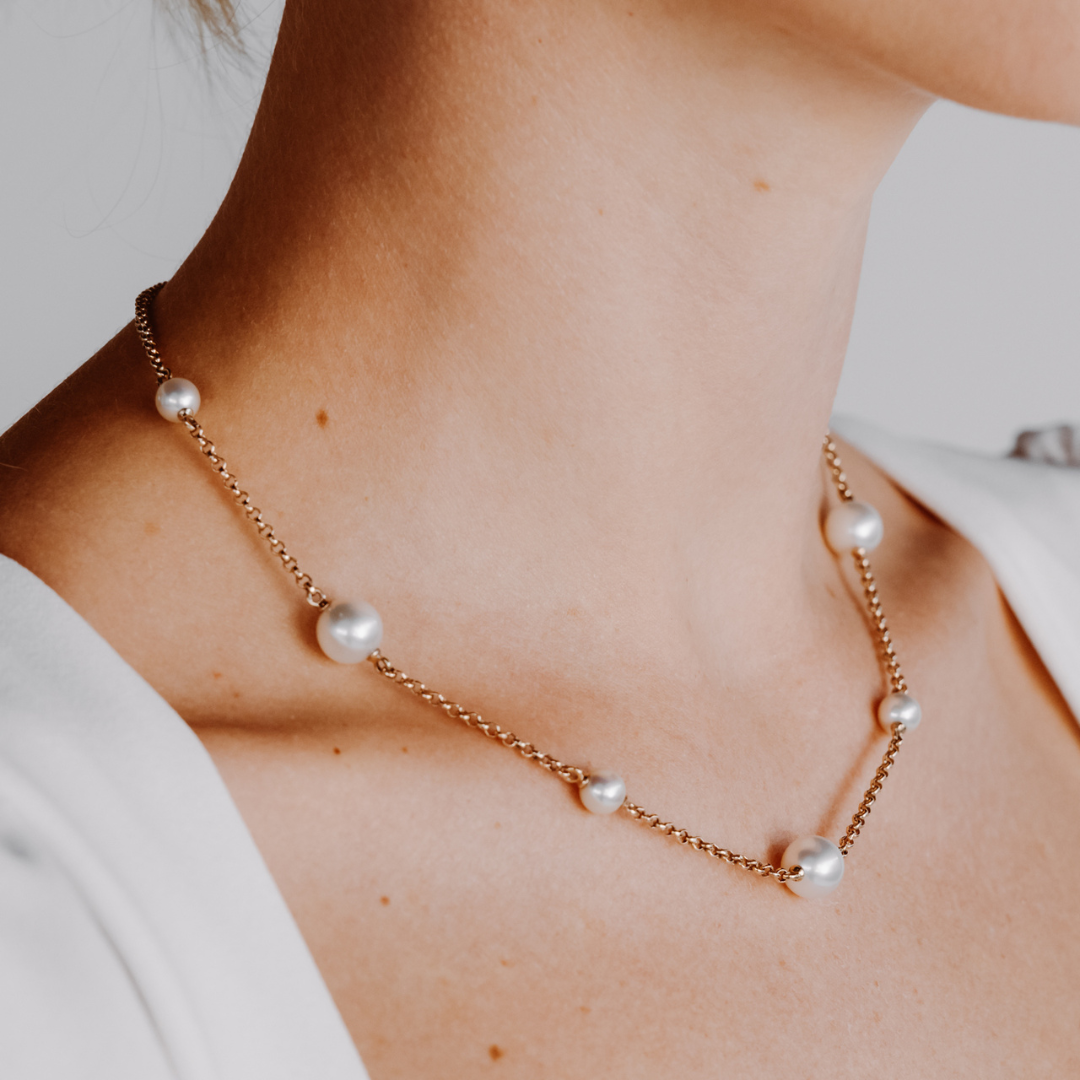
What Are Tahitian Pearls and How Are They Different From Australian Saltwater Pearls?
$0.00 AUD
Discover the difference between Tahitian pearls and Australian Saltwater pearls, South Sea Pearls and Akoya pearls in our latest blog post. Learn about their unique features as well as our Pearls of Australia’s Saltwater pearls.
The exotic black pearls referred to as Tahitian pearls come from the Pinctada margaritifera or the Black-lip shell. The name of the Tahitian pearl does lead you to think that they originate in Tahiti, but this is not the case! Although Tahiti is the main trading post, they are actually farmed and found in French Polynesia, the Cook Islands, the Micronesian Islands and the Abroholos Islands in Western Australia.
The tropical, warm waters of the South Pacific Ocean are ideal for culturing large saltwater pearls. Tahitian pearls are harvested after an 18 to 24 month growth period. The combination of warmer temperatures and a longer cultivation time for each pearl equates to pearls with very thick nacre, stunning lustre, and incredible colour.
Tahitian pearls are relatively new within the pearl market, with their popularity only rising in the mid-1900s. The people of Polynesia primarily harvested the black-lipped pearl oysters, and like most mother of pearl shell at some point in history, these shells were used extensively in jewellery, adornment, and decorations. The Tahitian pearls themselves were extremely rare until the practice of pearl cultivation arrived in the 20th century, where it wasn’t until 1972 that they started being exported from French Polynesia to across the world.
Unlike other pearl types, Tahitian pearls have a naturally dark colour and are the only naturally dark pearls. If you see Black Akoya pearls and black Freshwater pearls know that they have been dyed and chemically altered!
Although Black-lip shells are farmed in Japan, Thailand, and the Philippines, only those grown in French Polynesia can be called Tahitian pearls.
Australian saltwater pearls include South Sea and Akoya pearls, which we sustainably grow at our very own Cygnet Bay and Broken Bay pearl farms.
The colour range of the body of Tahitian pearls is quite extensive with a spectrum that begins at light and creamy whites, greys, greens, blues, purples, and deep blacks. These colours are referred to as the primary or body colours of the pearl. Additionally, these pearls display iridescent overtones which are referred to as secondary colours. This is because the Pinctada margaritiferaor Black-lip shell has a rainbow-like mantle which is then expressed in the Tahitian pearls.
When grading a Tahitian pearl, the most common primary or body colours include – Silvery-white (very rare), pale dove grey, light charcoal grey, medium charcoal grey, medium-dark charcoal grey, dark charcoal grey, very dark charcoal grey, very near true black (rare), jet black (rare).
The most popular and famous overtones are:
Although at Pearls of Australia we do not grow Tahitian pearls, we do grow rare and high-quality saltwater pearls in the form of Australian South Sea pearls and Australian Akoya pearls. Our locally and sustainably grown Pinctada maxima (South Sea) pearls are amongst the finest quality pearls grown anywhere in the world.
It is a lesser-known fact that Australia is home to the sub-tropical species of pearl shell known as Pinctada fucata (Akoya), and that a small quantity of Pinctada margaritifera black-lipped pearl shell are cultivated at the Abrolhos Islands.
Liddon Pearls from Post Office Island in Western Australia are a family based pearl farm that offer locally grown black pearl jewellery.
Not only are our pearls rare, pure and completely stunning to look at, but they also happen to be one of the few precious gems on the planet that contain regenerative and restorative qualities for our oceanic environment. This means when you purchase a pearl, you’re not only purchasing one of the rarest and most beautiful gifts of mother nature, but you’re also helping to facilitate the restoration of our pristine Australian waterways.
Few collections in the world can boast the purity, rarity, lustre and provenance of our Australian grown pearls. Pairing these visible and invisible qualities together with our elegantly crafted jewellery designs, we create pieces that are treasured for generations.
Prefer to talk to one of our Jewellery and Pearl experts before purchasing one of our pearl pieces? They would love to help you in any way, please contact them either by sending an email to hello@pearlsofaustralia.com.au or call (08) 6478 6886.
You can buy authentic Tahitian pearl jewellery online in Australia from specialist pearl jewellers who are able to provide origin transparency, grading details and a Certificate of Authenticity.
When buying Tahitian pearls online, choose a pearl specialist rather than a general jewellery retailer, and ensure the pearl type and origin are clearly stated.
Genuine Tahitian pearls show deep natural lustre, layered nacre, and subtle colour variations such as peacock, green, silver, and charcoal tones.
Fake pearls often appear overly uniform in colour, lightweight, or glassy in shine. Real Tahitian pearls will show natural surface characteristics rather than perfectly smooth coatings.
The safest way to avoid imitation pearls is to purchase from a trusted Australian pearl specialist like Pearls of Australia, were pearl type and grading is disclosed for our South Sea and Akoya pearls.
Tahitian pearls should be cleaned gently to protect their surface. After wearing, wipe your pearls with a soft, 100% cotton cloth. Avoid ultrasonic cleaners, harsh chemicals, detergents, or abrasive cloths.
Store Tahitian pearl jewellery separately from hard gemstones and metals to preven scratching. Pearls should be the last thing you put on and the first thing you take off when dressing.
Although we don't sell Tahitian pearls, our pearl care guide can be utilised when caring for your pearls. Proper care helps preserve your pearl over time.
Tahitian pearls are saltwater cultured pearls produced by the black-lip pearl shell called Pinctada margaritifera. They are known for their rich, naturally dark body colours and beautiful overtones. Despite often being called "black pearls", Tahitian pearls occur in a wide spectrum of shades including green, grey, silver, blue and peacock.
They are one of the major saltwater pearl types sold globally, alongside Australian South Sea and Akoya pearls.
There is no single "best" Tahitian pearl colour, value depends on lustre, overtone, surface quality, and personal preference.
However, highly sought-after colours include peacock and bright silver-grey.
Pearls with strong lustre and complex overtone layers are generally more valuable than pearls judged on body colour alone. Choice of colour often comes down to style, skin tone and jewellery design.
Tahitian pearls come from French Polynesia, where they are cultivated in saltwater bodies of water. They are grown in black-lipped oysters and farmed using careful marine aquaculture practices. Although named Tahitian pearls, they are produced across multiple islands in French Polynesia, not only Tahiti itself.
Almost all Tahitian pearls on the market today are cultured pearls, meaning human-assisted seeding begins the pearl formation process.
Natural (wild) Tahitian pearls are extremely rare. Cultured Tahitian pearls are still real pearls, they are formed by a pearl shell with human intervention. Cultured does not mean imitation, it means farmed.
Tahitian pearls are saltwater pearls. They are grown in ocean environments inside black-lipped pearl shell. This places them in the same broad category as Australian South Sea and Akoya pearls, which are also saltwater pearls.
Tahitian pearls appear black or dark because of the natural pigment of the black-lipped pearl shell that is secreted by the lip of the pearl shell.
The pearl shell's colouring influences the nacre layers, creating dark body tones with colourful overtones. True Tahitian pearls are not dyed black, their colour is naturally formed during pearl growth.
Their dark tones combined with green, peacock, silver or purple overtones are what make Tahitian pearls so distinctive.
Join our mailing list for regular sales, upcoming releases and insights into the world of positive pearling and ocean conservation